Preclinical Models of Parkinson’s Disease

AAV α-synuclein over-expressing rodent

α-Synuclein is the major constituent protein of aggregates in Lewy bodies, the pathological hallmark of Parkinson’s disease. Viral delivery of α-synuclein to the substantia nigra of rats or mice produces a slowly developing degeneration of dopaminergic neurons in the substantia nigra with behavioural deficits and molecular pathology analogous to that observed in people with Parkinson’s disease. 

Model Overview

AAV1/2-hA53T-α-synuclein vectors are injected unilaterally into the substantia nigra of rats or mice using stereotaxic techniques. Degeneration of dopaminergic neurons occurs over several weeks allowing test compounds to be evaluated for disease modifying potential.
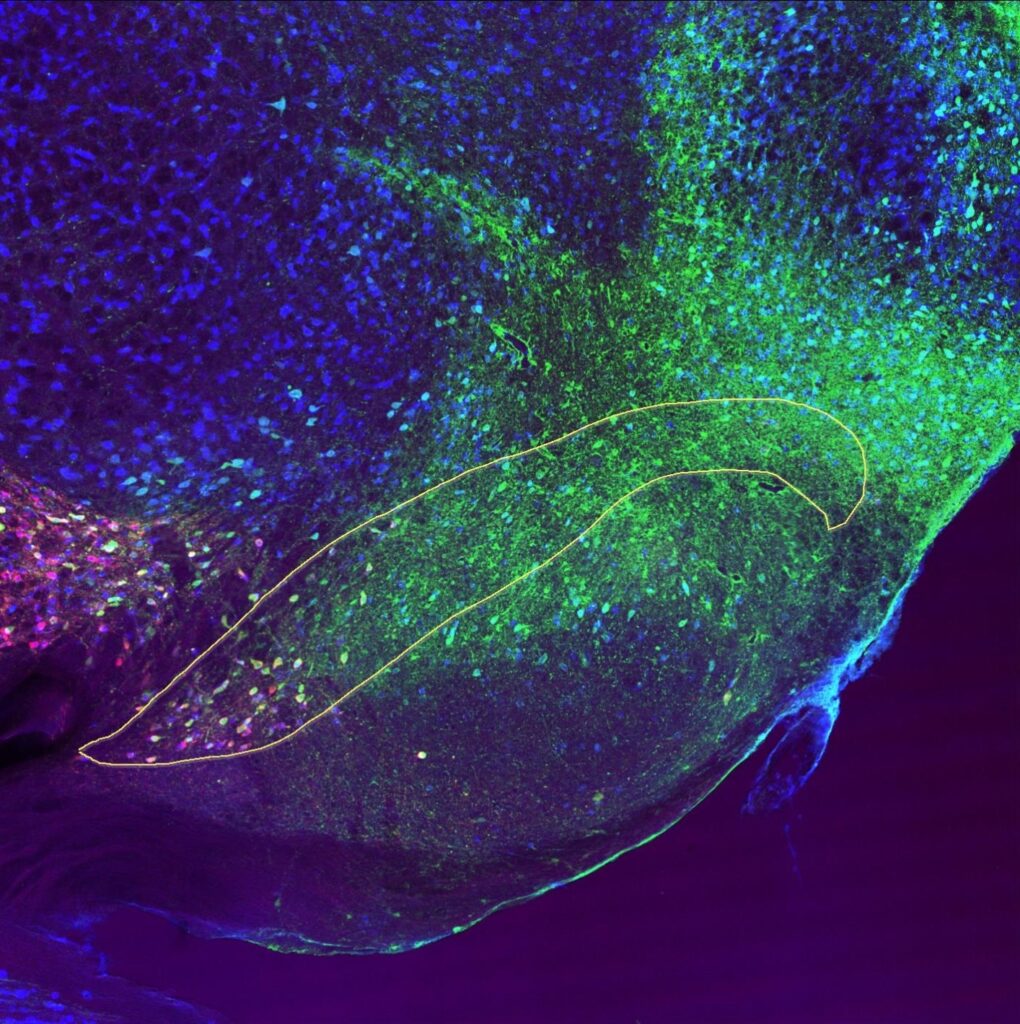
Slice through the rat brain showing the substantia nigra (marked by the yellow line) that has been stained with markers for three different proteins; green = α-synuclein, red = dopaminergic neurons, blue = all neurons.

  • Cells staining cyan = co-localisation of α-synuclein stain + neuronal stain
  • Cells staining magenta = co-localisation of dopaminergic neuron stain + neuronal stain
  • Cells staining yellow = co-localisation of α-synuclein stain + dopaminergic stain
  • Cells staining white = co-localisation of α-synuclein stain + dopaminergic neuron stain + neuronal stain

Robust loss on dopaminergic endpoints

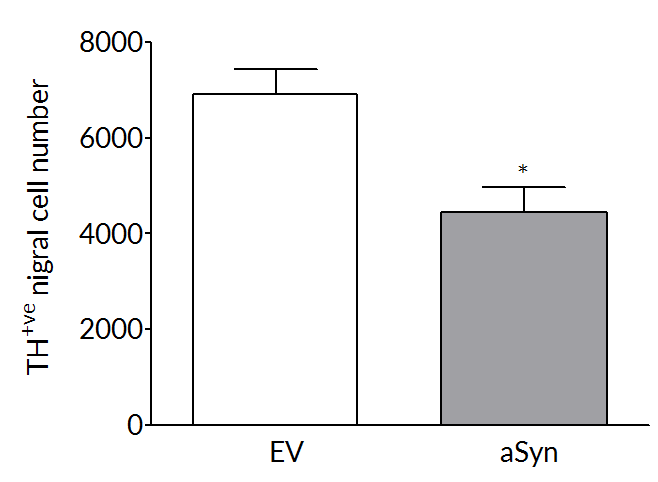
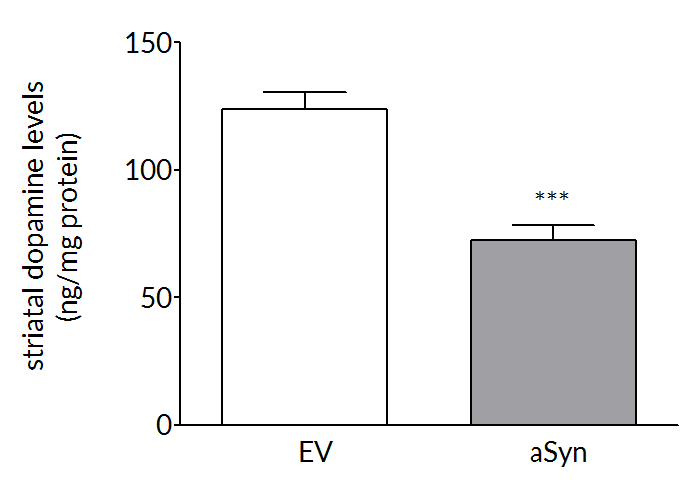
Dopaminergic cell loss develops over time so that at 6 weeks post-surgery there is a 35-45% loss of striatal dopamine (right) and tyrosine hydroxylase positive cells (left) in the substantia nigra.
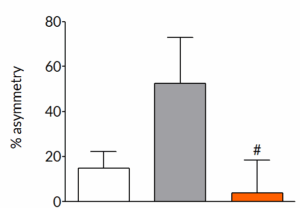
AAV-α-synuclein produces forelimb asymmetry that can be prevented by pharmacological intervention

Six weeks post-surgery, rats exhibit a pronounced forelimb asymmetry. Once daily treatment with trehalose, a known autophagy enhancer, completely prevents the development of forelimb asymmetry. This demonstrates that the model is able to identify compounds that can slow the progression of symptoms in the model.
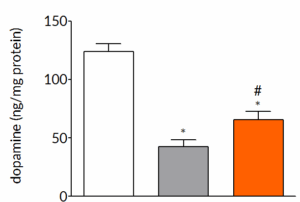
AAV-α-synuclein-induced loss of dopamine can be prevented by pharmacological intervention

Six weeks post-surgery, rats exhibit a pronounced loss of striatal dopamine. Once daily treatment with trehalose significantly reduces the striatal dopamine loss demonstrating that the underlying pathological changes that occur in the model can be modified by pharmacological intervention.
Experimental readouts

  • Behavioural – Behaviour is assessed by a cylinder test that examines forelimb asymmetry. The limb asymmetry indicates an imbalance in striatal dopaminergic function between the side injected with AAV1/2-A53T-α-synuclein and the contralateral side. 
  • Post-mortem – Routine post-mortem analyses include striatal dopamine, striatal α-synuclein expression and the number of tyrosine hydroxylase positive cells in the substantia nigra. Additional post-mortem measures can be incorporated at the request of the client.
  • Target engagement – Demonstration of target engagement can often be incorporated into the study design aiding translation from rodent studies to non-human primate studies and ultimately to clinical studies.
  • Imaging – We offer both MRI and PET imaging that allows longitudinal measurement of markers of dopaminergic function and metabolism. Imaging can also be used to demonstrate target engagement.
  • Pharmacokinetics – Can be incorporated into all studies. Blood can be sampled throughout the study and terminal samples of CSF and brain and other tissues can be collected.

Related Papers

AAV1/2를 이용한 흑색질 내 A53T-α-시누클레인의 과발현은 루이 소체 유사 병리와 운동 장애를 동반한 흑색선조체계의 퇴행을 유발함: 파킨슨병의 새로운 마우스 모델

Acta Neuropathologica Communications
Chi Wang Ip, Laura-Christin Klaus, Akua A. Karikari, Naomi P. Visanji, Jonathan M. Brotchie, Anthony E. Lang, Jens Volkmann, James B. Koprich

파킨슨병 시누클레인병증 설치류 및 영장류 모델에서 선조체 도파민 결핍에 대한 트레할로스의 유익한 효과

Journal of Pharmacology and Experimental Therapeutics
Patrick A. Howson, Tom H. Johnston, Paula Ravenscroft, Michael P. Hill, Jin Su, Jonathan M. Brotchie, James B. Koprich

파킨슨병 마우스 모델에서 CD11c+ 세포에 의한 알파시누클레인의 뇌-장 이동

Nature Communications
Rhonda L. McFleder, Anastasiia Makhotkina, Janos Groh, Ursula Keber, Fabian Imdahl, Josefina Peña Mosca, Alina Peteranderl, Jingjing Wu, Sawako Tabuchi, Jan Hoffmann, Ann-Kathrin Karl, Axel Pagenstecher, Jörg Vogel, Andreas Beilhack, James B. Koprich, Jonathan M. Brotchie, Antoine-Emmanuel Saliba, Jens Volkmann, Chi Wang Ip

뇌파 및 말초 혈액 내 파킨슨병 관련 면역 조절 장애를 차단하는 뇌 심부 자극술

Brain, Behavior, and Immunity
Rhonda L. McFleder, Thomas Musacchio, Johanna Keller, Susanne Knorr, Tobias Petschner, Jiazhi Chen, Muthuraman Muthuraman, Mohammad Badr, Lisa Harder-Rauschenberger, Fabian Kremer, Selin Asci, Sophie Steinhauser, Ann-Kathrin Karl, Jonathan M. Brotchie, James B. Koprich, Jens Volkmann, Chi Wang Ip

CD28 초작용성 항체에 의한 조절 T 세포 확장은 A53T-α-시누클레인 파킨슨병 마우스 모델에서 신경 퇴행을 완화합니다

Journal of Neuroinflammation
Mohammad Badr, Rhonda L. McFleder, Jingjing Wu, Susanne Knorr, James B. Koprich, Thomas Hünig, Jonathan M. Brotchie, Jens Volkmann, Manfred B. Lutz, Chi Wang Ip

신규 AAV1/2 벡터를 이용한 쥐 흑색질에서의 인간 A53T 알파-시누클레인 발현은 단백질 응집, 이형성 신경돌기 구조, 그리고 흑색선조체 퇴행을 동반하는 급진적 병리를 유발하여 파킨슨병의 병리학적 모델링 가능성을 보여줍니다

분자 신경퇴행
James B Koprich, Tom H Johnston, M Gabriela Reyes, Xuan Sun, Jonathan M Brotchie

GM1 강글리오사이드의 알파-시누클레인 독성 완화 및 랫드 파킨슨병 모델에서의 신경 보호 효과

Scientific Reports
Jay S. Schneider, Radha Aras, Courtney K. Williams, James B. Koprich, Jonathan M. Brotchie, Vikrant Singh

진행성 파킨슨병 모델에서 인플라마좀 억제를 통한 알파시누클레인 병리로부터의 도파민성 뉴런 보호

Journal of Neuroinflammation
Alexander Grotemeyer, Judith F. Fischer, James B. Koprich, Jonathan M. Brotchie, Robert Blum, Jens Volkmann, Chi Wang Ip

A53T 파킨슨병 래트 모델에서 낮은 베타파(β)를 통한 운동 출력 및 세포 퇴행 예측

Brain
Katarina Hofman, Jia Zhi Chen, Tanmoy Sil, Franziska Pellegrini, Stefan Haufe, Nicolo Pozzi, Chiara Palmisano, Ioannis Isaias, James B Koprich, Jonathan M Brotchie, Andrea A Kühn, Cordula Matthies, Martin M Reich, Muthuraman Muthuraman, Jens Volkmann, Chi Wang Ip

AAV-A53T-α-시누클레인 파킨슨병 마우스 모델에서의 α-시누클레인 특이적 T 세포에 의한 신경 퇴행

Brain, Behavior, and Immunity
Akua A. Karikari, Rhonda L. McFleder, Eliana Ribechini, Robert Blum, Valentin Bruttel, Susanne Knorr, Mona Gehmeyr, Jens Volkmann, Jonathan M. Brotchie, Fadhil Ahsan, Beatrice Haack, Camelia-Maria Monoranu, Ursula Keber, Rima Yeghiazaryan, Axel Pagenstecher, Tobias Heckel, Thorsten Bischler, Jörg Wischhusen, James B. Koprich, Manfred B. Lutz, Chi Wang Ip

알파-시누클레인 용량 감소로 유발된 파킨슨병 동물 모델에서의 진행성 신경퇴행 또는 내인성 보상

PLoS ONE
James B. Koprich, Tom H. Johnston, Philippe Huot, M. Gabriela Reyes, Maria Espinosa, Jonathan M. Brotchie

바이러스 발현 돌연변이 α-시누클레인 파킨슨증 쥐 모델에서 미토콘드리아 생체 에너지 안정을 통한 서투인 3(Sirtuin 3)의 신경 보호 효과

Neurobiology of Disease
Jacqueline A. Gleave, Lindsay R. Arathoon, Dennison Trinh, Kristin E. Lizal, Nicolas Giguère, James H.M. Barber, Zainab Najarali, M. Hassan Khan, Sherri L. Thiele, Mahin S. Semmen, James B. Koprich, Jonathan M. Brotchie, James H. Eubanks, Louis-Eric Trudeau, Joanne E. Nash

A53T α-시누클레인 파킨슨병 쥐 모델에서 시상하핵 심부 뇌 자극술의 신경 보호 효과

Annals of Neurology
Thomas Musacchio, Maike Rebenstorff, Felix Fluri, Jonathan M. Brotchie, Jens Volkmann, James B. Koprich, Chi Wang Ip

AAV-A53T α-시누클레인 파킨슨병 랫드 모델에서 도파민성 신경 퇴행의 시간적, 공간적 및 분자적 패턴

Behavioural Brain Research
Thomas Musacchio, Jing Yin, Fabian Kremer, James B. Koprich, Jonathan M. Brotchie, Jens Volkmann, Chi Wang Ip

트레할로스 치료는 AAV 알파-시누클레인 파킨슨병 래트 모델에서 발생하는 행동 및 신경화학적 결손을 예방합니다

분자신경생물학 (Molecular Neurobiology)
Qing He, James B. Koprich, Ying Wang, Wen-bo Yu, Bao-guo Xiao, Jonathan M. Brotchie, Jian Wang

당사 사이트 및 시설

세계 수준의 시설, 글로벌 네트워크

Atuka’s partners benefit from experienced scientists using advanced technologies at leading-edge research facilities in Canada and China.

중국 쑤저우

  • 원숭이 생체 내(in vivo) 시설
  • 생체 내(in vivo) 영상화
  • 외과 연구
  • 생체분석 서비스
  • 행동 연구

캐나다 토론토

  • 설치류 생체 내(in vivo) 실험실 
  • 생체 외(in vitro) 실험실 
  • 행정 사무소 

Atuka의 최신 과학 연구 소식을 받아보세요

파킨슨병 연구의 최신 동향을 담은 분기별 뉴스레터를 받아보시려면 구독하세요.

메일링 리스트 등록