Assessment of anxiety-like behaviours in the macaque
Anxiety is a complex psychological state in which typically harmless environmental stimuli provoke negative emotional expectations. In humans, anxiety disorders are multifaceted, arising from both biological and experiential origins, and can range from situational to chronic in nature. This wide spectrum underscores the importance of models that can disentangle the various components and underlying causes of anxiety to inform effective clinical interventions.
The macaque serves as a vital intermediary between NHP species and humans, due to their high intelligence, complex social networks and emotional parallels with humans. The human intruder test (HIT) is one of the most widely used tests to measure anxiety in macaques. The HIT is designed to measure an individual’s response to a potentially threatening social stimulus of an unfamiliar ‘human intruder’. We assessed the HIT response in female MPTP-lesioned macaques. Each animal was placed in an observation cage and an ‘intruder’ entered the room and presented their side profile to the animal for a total of 9 minutes. The intruder then exited and the monkey was left for 3 minutes. The intruder then re-entered the room and stared directly at the animal for a further 9 minutes. Behavior was videotaped and analyzed by an observer blinded to treatment using a behavioral ethogram that can detect anxious / depressive behaviors. To evaluate the pharmacological responsiveness of the anxiety-like behaviours observed during the HIT, we characterized HIT responses associated with administration of non-sedating doses of the benzodiazepine, alprazolam (PO). To first identify a non-sedating dose of alprazolam we performed a dose-response study to determine the effect of alprazolam on activity levels in the MPTP-lesioned macaque.
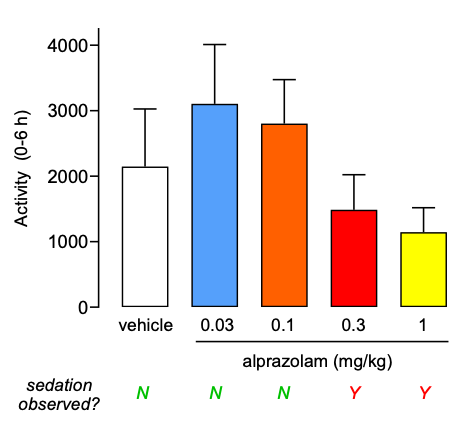
The effect of non-sedating, oral alprazolam in the HIT were assessed (Figure 2).

These results demonstrate that the HIT assessments in the macaque can discern anxiety-like behaviours that are responsive to clinically employed anxiolytic therapies.
Behavioural Ethogram
| Category and Specific Behaviour | Measurement |
|---|---|
Fearful defensive behaviours Freeze — Rigid, tense, motionless posture except slight head movement Crouch — Whole body or just front limbs with head near floor Withdrawal — Quick, jerky motion away from intruder (jump back) Fear grimace — Refracted lips, exposed clenched teeth (exaggerated pain) | Cumulative frequency |
Hostile defensive behaviours Threat bark vocalisation — Low pitch, high intensity, rasping, guttural Threat (facial expression) — Any of: open mouth (no teeth exposed), head-bobbing, ear flapping Cage aggression — Vigorously slaps, shakes or slams body against cage Lunge — A quick jerky movement towards the intruder | Cumulative frequency |
Anxious behaviours Scratch — Rapid scratching of body with hands or feet Body shake — Whole body or just head and shoulder region shakes Tooth grind — Repetitive, audible rubbing of upper and lower teeth Yawn — Open mouth widely, exposing teeth | Cumulative frequency |
Stereotypies Pacing — Repetitive motor pattern around test cage Motor stereotypy — Repetitive, abnormal voluntary or involuntary motor patterns Self-directed — Sucking thumb, eye poke, self-bite | Cumulative duration |
Affiliative behaviours Coo vocalisation — Clear soft, moderate in pitch and intensity, usually ‘oooh’ sounding Grunt vocalisation — Deep, muffled, low intensity, almost gurgling sound Lipsmack — Rapid movement of pursed lips, accompanied by a smacking sound Present — Rigid posture (knees locked) with tail elevated and rump orientated toward intruder | Cumulative frequency |
Scream vocalisations — High pitch, high intensity screech or loud chirp | Frequency |
Cage explore — Calm and inquisitive inspections of cage; tactile, oral or visual means | Duration |
Self-sooth Self-grooming — Use hands or mouth to smooth or pick through fur Self-clasping — Non-manipulatory enclosing or holding of a limb or body part with arms | Cumulative duration |