
DECEMBER 8, 2025
By Dr. Jonathan Brotchie
I recently spent two days at a couple of events organized by the Michael J. Fox Foundation in New York. The first day, under the heading “Partnering Session”, was devoted to the foundation’s strategy around partnering, while the second was the MJFF’s annual Parkinson’s Disease Therapeutics Conference, both of which offered a clear view of the areas where MJFF are focused on right now. It also gave the best picture you could hope for of how researchers, clinicians, and companies are reading the current moment in Parkinson’s research.
Dr. Gennaro Pagano (Roche) captured the mood with a line I noted at the time: “Parkinson’s research has entered an unprecedented phase of biological clarity.” I couldn’t have said it better myself. At last year’s meeting there was a palpable buzz following the publication of some great papers on the biological basis of disease in PD and the emerging alpha synuclein seed amplification assays (aSyn-SAA). We were all excited that a new world was about to dawn. Further progress achieved this year around disease biology and biomarkers has taken that excitement to the next level, as that new dawn becomes a reality for MJFF and a lot of us in the field.
This clarity of biology can now lead to a clear path forward in developing drugs. In just 12 months, the science has coalesced in a way that allows people to see a path forward more clearly. Having visibility on that route allows us to plan more effectively. We don’t yet have a cure, but for the first time we’re beginning to see how we will get one.
Several of the sessions reflected this feeling. As someone who started working on developing symptomatic therapies for PD way back in the 1980s, then became focussed on disease modification in the late aughts, it is not only rewarding to see how the field has moved towards that biological clarity of disease but it seems we will likely also need to focus back more on symptomatic therapies as we develop biologically focused strategies for disease modification.
There is an emerging need for better motor symptomatic therapies. With the advances we have made in models and mechanisms, aligning with the translational strengthening that comes from the biologically based definitions of disease mechanism, there’s also real opportunity to leverage our understanding of non-motor symptoms such as sleep issues, cognitive decline, orthostatic hypotension and depression/apathy.
Endolysosomal Dysfunction
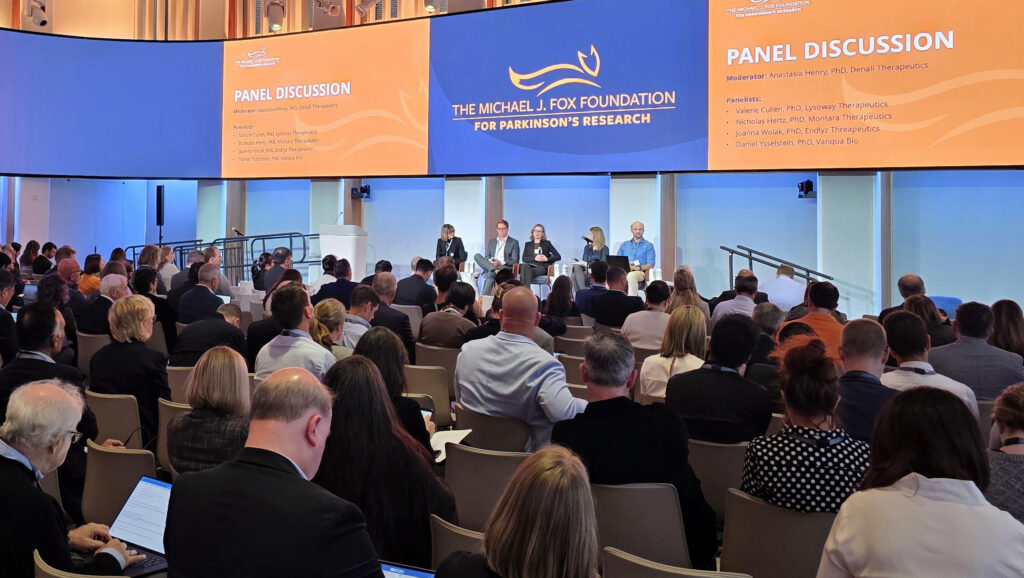
This session featured work from Nicholas Hertz (Montara Therapeutics), Joanna Wolak (Endlyz Therapeutics), Valerie Cullen (Lysoway Therapeutics), and Daniel Ysselstein (Vanqua Bio), across targets including LRRK2, TRPML1 and GCase. Of course these are targets we have a lot of experience with at Atuka and it’s nice to see the MJFF successes in this space all in one place, and also see how synergy in both thinking and application emerge when considering pathways, not just single targets, as an approach to therapeutics development.
The discussions focused less on debating the value of individual targets and more on the practical hurdles that apply across disease-modifying approaches—particularly patient stratification, quantitative biomarker development, and the move toward smaller, genetically enriched trials. These points have also been coming through the Partnering Session, and MJFF appear to be hearing them consistently from many of the scientists they support.
Immune Mechanisms
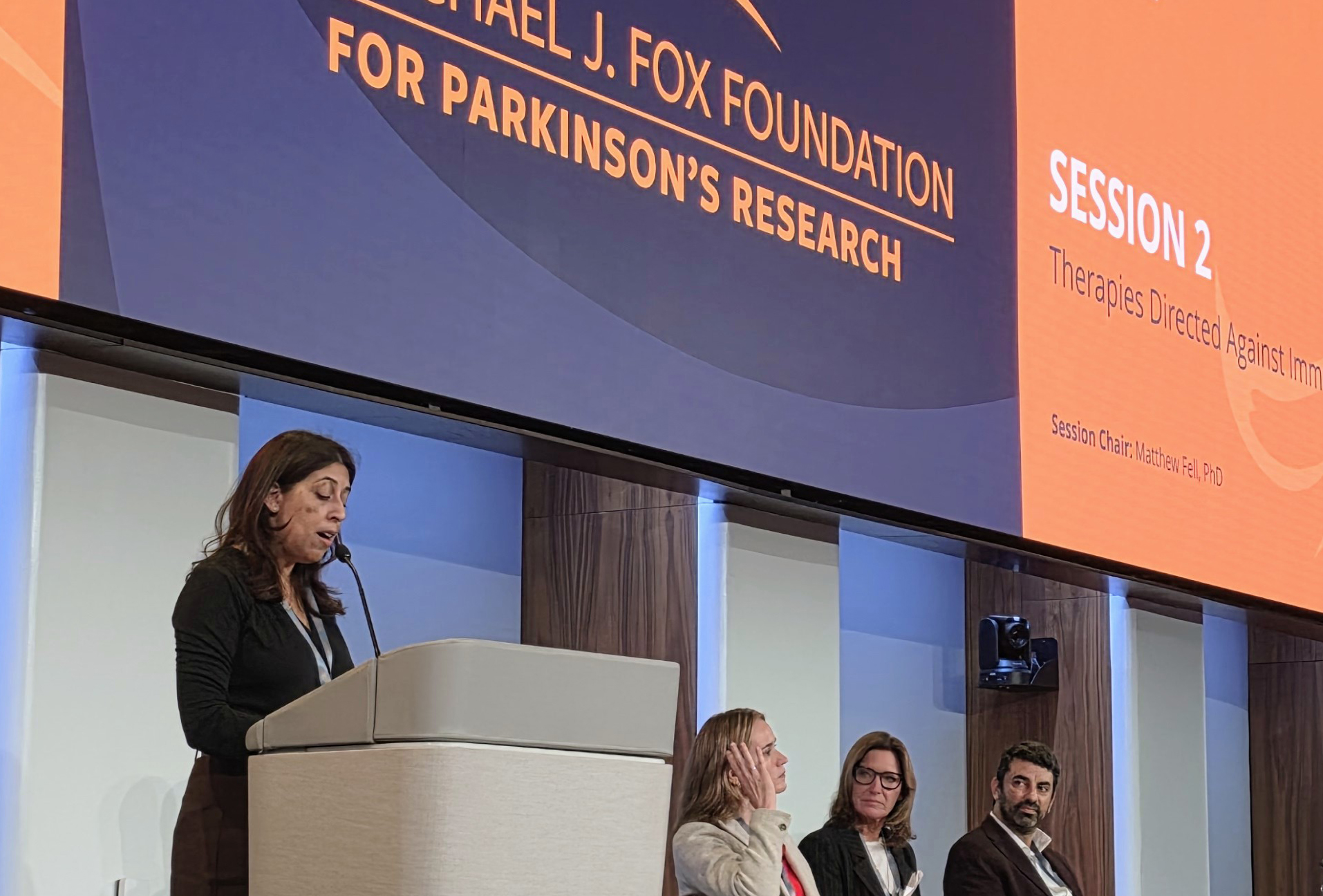
The immune block, chaired by Dr. Matthew Fell (Merck), centred on work presented by Dr. Scott Shandler (Longevity Biotech) on VIP biology, Dr. Becky Crean (Ventyx Biosciences) on NLRP3 inhibition, and Dr. Louise Frank (Vesper Bio) on sortilin inhibition and progranulin. Much of this sits within the coordinated activity of the MJFF Immune Consortium, which brings structure through shared protocols, standardised assays, and common datasets.
A theme here—and in the Partnering Session—is that immune dysfunction likely characterizes only a subset of people with Parkinson’s. That raises questions about how best to approach stratification and where certain preclinical models might align with those needs. The panel discussion brought out practical considerations around biomarkers (CSF, plasma cytokines, progranulin), sample timing, and the variability of immune measures, as well as the ongoing discussion around the relevance of animal models for these mechanisms.
Again, I was struck by the potential amplification of impact that happens when consortia of scientists are grouped by pathways, not targets. The synergy emerging from sharing approach, core technology platforms, and non-competitive data is overwhelming. As a community, we need to be doing more of this. MJFF is making a profound impact in this way, and with several of their themes embracing and driving multi-group collaboration as a means to accelerating treatments and cures.
At Atuka, collaboration has always been one of our core values. From here, we see that uptick in impact that comes when collaboration moves from being bidirectional with a single partner, to acting as part of a general network. We need to make sure we optimize how we work to form and support pathway-focused consortia. With experience across many targets and pathways, and an emerging understanding of how to deploy our range of preclinical models appropriate and relevant for those pathways, we are in a good position to empower consortia-driven progress.
Biomarker and Analytical Tools
This session generated a lot of anticipation, reflecting how quickly this area is moving.
Dopaminergic imaging
Dr. Ken Marek (IND/PPMI) showed how reprocessing thousands of DAT and VMAT scans through the MIAKAT pipeline sharply reduces variance—an advance that could reshape how imaging is deployed in trials. He also outlined new tracer harmonisation efforts and early results from the NeuroExplorer PET camera. I really think we should be thinking of applying this approach to our imaging in non-human primate models of PD.
α-synuclein PET
Dr. Cong Liu (Shanghai Institute of Organic Chemistry) and Dr. Roger Gunn (Xing Imaging) presented compelling new data on the 18F-FD4 tracer across rats, marmosets, and early human subjects. The enthusiasm in the room made clear how significant this could become for future efficacy readouts. We will be watching this with a great deal of interest over the next few months.
It feels like aSyn imaging has finally reached the stage where we will be able to apply it to our models as well as at Phase II, taking our translational efforts to a level of much higher likelihood of success. I believe we’ll see this first in the arena of appropriate target engagement, and then in better alignment between our models and stratified patient populations.
Quantitative seed amplification assays
Dr. Tuomas Knowles (University of Cambridge) introduced a digital droplet version of the α-syn SAA that produces quantitative measurements rather than a simple positive/negative result—substantial progress compared to last year.
Multimodal modelling
Finally, Piet Aarden and Dr. Mari Niemi (Novartis) shared modelling work integrating clinical, imaging, and multi-omics data from PPMI to place individuals along a unified disease timescale.
Taken together, these talks showed how rapidly quantitative, biologically grounded tools are maturing across imaging, fluid biomarkers, and computational frameworks.
Value, Evidence, and Access
In the closing panel moderated by Katie Kopil of MJFF, the discussion between Dr. Billy Dunn (MJFF), Dr. Gennaro Pagano (Roche), Dr. Bryan Tysinger (USC), and Fred Goldstein (Accountable Health) addressed how emerging biomarkers will interact with regulatory expectations, payer decision-making, and definitions of meaningful benefit.
Billy Dunn emphasised that slowing disease progression—when supported by biological evidence—should be considered a meaningful endpoint, drawing on lessons from SMA, ALS, and Alzheimer’s. Fred Goldstein spoke about the distinction between approval and access, highlighting the importance of scalable, predictive biomarkers for payers.

What I’m Taking Forward
I left the conference with the real sense that several strands of Parkinson’s research are beginning to meet in the middle. The work on α-syn PET, the progress toward quantitative seed amplification assays, and the refinements in dopaminergic imaging all point to a future in which we can measure the biology of the disease and align with mechanism in our preclinical models with far more confidence than even a year ago. That shift matters—not just for companies developing therapeutics, but for anyone trying to understand how Parkinson’s unfolds and how we might interrupt it.
The emphasis on stratification—along the lines of mechanism but also stage of development—also felt important. Across lysosomal, immune, and imaging discussions, there was an acknowledgement that we are finally understanding enough about Parkinson’s to see how it is a story of mechanisms that evolve, and that the timing and stage of that story matters. It’s a book that has chapters we are starting to be able to define, in patients and with modelling—chapters which come together to form a single biological story. It’s encouraging to see and idea that has been there in different forms through my entire career now gaining practical traction.
The programmatic work MJFF is leading gives the research landscape a structure that didn’t exist in quite the same way before. Bringing groups together around shared tools and shared questions seems to be helping the field move with more coordination. That shift aligning with the biology is a big deal.
The day of the Therapeutics Conference ended with the short film Everything Needs a Starting Point. By the end of it I found myself thinking again about why these technical advances matter. People with Parkinson’s spoke plainly about what even small changes in the pace of progression would mean for their work, independence, and everyday life. Every extra month we can give a patient with preserved function matters. It was a moving reminder that the details discussed across the day—the imaging analytics, the assays, the models—are in service of something very real for the people living with this disease.